Tuesday, February 15, 2011

Malaysian Fresh Spring Rolls (Popiah)

Things always cluster in threes, they say, so I feel compelled to complete what appears to be a series about my favorite childhood Nonya foods with the third entry: Fresh Spring Rolls, or "popiah". We frequently had popiah as an appetizer to be followed by either Sarawak Laksa or Hainanese Chicken Rice. At a kopi tiam (casual food court), the popiahs would arrive assembled and ready to eat. My third aunt often had popiah parties, where one would assemble one's own popiah out of prepared ingredients; this is how I serve popiah at home. So, without further ado, this is how we eat popiah at Chez Huxley Wuxley.

First, you need to get together these ingredients:

Wrapper skins, preferably Menlo wrappers (these are made in Menlo Park, CA and are available in most Asian groceries/supermarkets; in Kuching, you would just buy a bunch of freshly-made skins from your favorite popiah lady):


Condiments, including Hoisin sauce & Sriracha hot sauce, lettuce leaves, and freshly ground roasted peanuts:


Thinly-sliced, steamed chinese sausage:


Blanched bean sprouts, thinly-sliced plain omelette, and thinly-sliced fried tofu cubes (the last is optional because I decided I don't really like them):


And, most important of all, popiah fillling, consisting primarily of jicama (recipe follows):


To make popiah filling, saute 4 finely chopped peeled garlic cloves and 3 tablespoons finely chopped dried shrimp (previously softened in hot water) in 2 tablespoons oil until fragrant. Mix in 2 medium peeled and julienned jicamas and about 6 finely julienned black dried chinese mushrooms (previously soaked in hot water to soften), turn heat to low and cover and cook gently for about 10 minutes. The jicama will release moisture and steam in its own juices. When it is cooked to your liking, make a sauce with 2 tablespoons soy sauce, 2 teaspoons oyster sauce, 1 tablespoon sesame oil and 1 tablespoon cornstarch. Make a well in the vegetables, pour in the sauce and let cook a little before stirring to mix. Cook over low heat and reduce until mixture is somewhat dry. Add about a cup of peeled, coarsely chopped fresh shrimp and mix until shrimp is cooked through. Turn off the heat and mix in some chopped scallions.

OK, now you are ready to assemble your popiah. First layer your plate with a Menlo wrapper, place a lettuce leaf on it and drizzle hoisin sauce and sriracha hot sauce over the leaf.


Then place a little of the popiah filling, the blanched bean sprouts, the sliced omelette and fried tofu on top of the lettuce leaf. Sprinkle with the sliced cooked chinese sausage and ground roasted peanuts.


Then roll everything up like a burrito. This is what Dave's looks like:


You are ready to take a bite!


Yum! There is the crunch of the lettuce leaf, the crisp-cooked jicama and the bean sprouts; the savory-sweet-spicy flavor of the condiments, the chinese sausage and the cooked sauce; the umami-ness of the fresh & dried shrimps and the mushrooms; and the nuttiness of the ground roasted peanuts. Somehow everything comes together magically to make - you've guessed it - the most delicious spring roll ever!

Friday, February 4, 2011

Very English Meat Pie

Dave brought my attention to this hilarious interview of his favorite chef in San Francisco:

Offal Chef Chris Cosentino Is Happy to Make a Meat Dress for Lady Gaga

The title says it all. The funny thing is, I can totally envision a tripe dress looking like an ethereal white tulle gown. You absolutely have to read the article; it is too funny for words but this guy can totally make fish sperm taste good (I would know: I've had it at his restaurant).

Anyway, all the talk about offal reminded me of a meat pie recipe from an article in the New York Times magazine that I had once made because the recipe was associated with Fergus Henderson, another chef proponent of offal and author of the cookbook "The Whole Beast: Nose to Tail Eating", whom we had actually sat behind once during a memorable dinner at Chris Cosentino's restaurant.

I always thought of it as "Fergus Henderson's Meat Pie" but when I dug up the recipe, it was only associated with the guy insofar as the use of the optional "Trotter Gear" in the meat pie. Now, it was a Sunday when I thought to make the pie, and my butcher shop where I might have gotten some pig's trotters was closed, so I opted to use the suggested cheddar cheese substitute instead. So my version of the pie didn't have much to do with offal, but oh well. Maybe next time...


We had it with peas on the side, not mushy peas like they would have had in London, but nice barely-cooked peas. And a pint each of Anchor Christmas Ale! There was enough left over for several lunches and dinners. That stuff is really filling. Maybe I'll make it again in a few years, perhaps with the Trotter Gear this time.

Wednesday, February 2, 2011

Hainanese chicken rice

In my last post, I said that Sarawak laksa is the best dish ever, but another dish that comes a close second when it comes to childhood comfort food that I crave, is Hainanese Chicken Rice. Luckily, this dish is easy to put together with widely available ingredients and requires no covert smuggling of secret spice mixes from halfway around the world. In fact, I made it once for a dinner party many years ago at my friend Amanda's and it was the hit of the party. Amanda kept asking me for the recipe but I never got it to her, in large part because my version of Hainanese Chicken Rice is an amalgam of two different recipes, from these two cookbooks:


so it wasn't an easy matter of just sending her photocopies of the recipes; I'd have to stipulate which parts I used from which recipe and when. In a way this post is for Amanda: after more than 5 years (!), here is the Hainanese Chicken Rice recipe you asked for. Sorry for the delay, but better late than never, right?

First, what is Hainanese Chicken Rice? Again, it is one of those wonderful Sarawak Nonya dishes that is somehow more than the sum of its parts. There is rice cooked with shallots and garlic and rendered chicken fat in a good chicken broth, served with poached chicken marinated with a dark sauce and a dipping sauce of fresh red chillies, ginger, garlic, chicken broth and lime to pull it all together. But what a dish! I cannot really describe the unctuous mouth-feel of the rice, the delicious tang, heat and gingeriness of the dipping sauce, and the silkiest, tenderest chicken you have ever tasted.

Here is a picture of my most recent attempt:


The cucumber salad on the side is not authentic, but I think it goes beautifully with the traditional chicken, rice and dipping sauce. The recipe for the cucumber salad is from the New York Times, originally intended to accompany bluefish and rice. I have also served it with Vietnamese grilled meat patties; in fact, it pairs wonderfully with any South East Asian rice-and-meat dish, and especially Hainanese Chicken Rice, which is traditionally served with cucumber slices.

Alright, this is how I make Hainanese Chicken Rice:

Take a small chicken (about 3 pounds), trim it of excess fat and rub all over with salt. Reserve the trimmed fat - you will use it for the rice later on. In a large pot big enough to hold the chicken, boil 8 cups water with 8 cloves garlic (in their skins, smashed) and 5 slices fresh ginger (smashed). Lower the chicken into the pot, immersing it in the boiling water, weighing it down if necessary. Cover and boil for 10 minutes. Turn off the heat and let the chicken sit in the hot water without removing the lid, for 2 hours. At the end of the 2 hours, remove the chicken and plunge into ice-cold water for 10 minutes.

In the meantime, prepare the rice. Render the chicken fat (there should be about 1/3 cup), throw out the unrendered brown bits and then sautee 3 chopped shallots and 3 chopped garlic cloves until light brown. Add two cups jasmine rice (or a long-grained rice) and sautee briefly to coat the grains. Add 4 cups chicken broth (it can be from the water used to boil the chicken, which is now a stock) and salt to taste, bring to a boil, give everything a good stir and then lower the heat to low and cover tightly. The rice is done when the liquid has been absorbed and there are steam holes on the surface of the rice, about 20 minutes.

When the chicken is done, tear the meat from the carcass. Make a marinade by mixing 1/4 cup soy sauce, 1/4 cup chicken broth, 1 tablespoon sesame oil, 1 tablespoon oyster sauce, and 1/2 teaspoon sugar. Mix the chicken meat in this marinade.

Make the dipping sauce. Now, this is the most important part of the dish. It is absolutely essential and brings everything together. Do not even think of attempting this dish without the dipping sauce! Mix together: 5 fresh red chilies (stemmed, seeded and chopped) or 1 1/2 tablespoons or more (or less) of sambal oelek if you are too lazy to stem and chop fresh chillies (which is what I do), 4 cloves chopped garlic, 1 tablespoon finely grated fresh ginger, 1 teaspoons sugar, 1/2 teaspoon salt, the juice from one lime and 1/4 cup chicken broth. I usually taste and may add more ginger, lime juice, salt or sambal oelek. It should be tangy and gingery, with a nice fresh red chilli flavor. The chilli has to be red chilli, no green chilli substitutions!

To serve, place a portion of rice with some chicken and dribble dipping sauce over all. (I like to dribble a lot of dipping sauce; in fact, back home we use it like a dressing). Place a portion of the non-authentic cucumber salad on the side. This may not be traditional, but I promise you, it makes the dish even better! Sit back and enjoy!

Amanda, I hope you like the post and will let me know how the dish turns out when you get David to make it!

Sunday, January 23, 2011

Borneo cuisine: Sarawak laksa

This morning, during breakfast with the Sunday New York Times, I was thrilled to see that they had written a very nice travel article about Kuching, a town on the island of Borneo that I had grown up in. The writer highlighted various things that immediately brought back fond memories, including a mention of my favorite dish in the whole world: Sarawak laksa, which he describes as a fiery noodle soup. It is hard to describe what laksa tastes like to the uninitiated; somehow the whole is greater than the sum of its parts, so simply to say that it consists of rice noodles bathed in a spicy, shrimpy, coconut broth and garnished with shrimp, shredded chicken, beansprouts and strips of omelette is not really doing it justice. Sarawak laksa is like the best thing you have ever tasted multiplied by ten. Here is a picture of it in the New York Times print article (the on-line article is missing this picture for some reason)


So, the way you might enjoy laksa without having to travel halfway around the world to Kuching is to acquire the laksa secret spice paste mix, perhaps from a friend or relative visiting you from Kuching who has smuggled this precious substance in a suitcase that has miraculously escaped detection by the Beagle Brigade at San Francisco airport. The precious bricks of laksa paste are kept in a safe place in your refrigerator and only very rarely broken out for very special meals. As you use up more and more of your stash, you start to hoard what you have left very jealously. Home-made laksa might be had no more than once a year, unless you can locate someone who can smuggle this stuff for you more frequently than once every few years.

I decided that the nostalgia induced by the article was a good enough reason to break out the second-to-last brick of laksa paste I still have in my refrigerator. It looks like this:


and is actually quite simple to use. First, you make a good stock (preferably from shrimp heads, or chicken or pork bones if you can't locate shrimp heads) and then you add the laksa secret spice mix and boil it in the stock for about an hour. You then strain the result and add coconut milk. Separately, you cook peeled shrimp and chicken in the stock and shred the chicken. You make an omelette and cut it into strips. You boil some rice noodles and drain them. Then you assemble the famous laksa dish. In a bowl, you add a nest of rice noodles, top it with some crunchy bean sprouts, the shredded chicken, the shrimp and the omelette strips. Then you ladle the laksa broth over all, sprinkle with cilantro leaves, a squeeze of lime, and serve. Voila!


The most delicious dish in the world. Ever.

In Kuching, laksa is a morning breakfast dish. If you venture out looking for a bowl any later than 11 am, you are bound to be disappointed. We had this for dinner tonight, but I am really looking forward to my breakfast tomorrow morning.

Huxley Beagle was very excited about laksa. He sniffed the air very intensely and was more doggedly hanging by the stove waiting for me to drop food than usual. I think he senses that the humans are eating the best thing ever, too! He would like Kuching. All the outdoor hawker centers where people eat and drop food he can scavenge, the giant rafflesia flower that smells like rotting meat - it would be paradise for a beagle!

Wednesday, December 29, 2010

Huxley CK452 Superdog


Dave commissioned this painting for my birthday. I was blown away! He was very mysterious for months, hinting at something big and I never could have guessed what it turned out to be. The artist is Sirron Norris who did some murals in the Mission district that I've long admired.

Everything in the painting really happened in real life. Huxley was CVFBAE the research beagle, who tested experimental heart medication CK452 before he retired from research and got adopted by us. He's got a permanent tattoo on his ear that marks him as CVFBAE. He hates cats and water, and his favorite toy is his rainbow ball. He loves visiting Lucca Ravioli with me and plunging his head into my shopping bag and sniffing the cheese and salami in it. He loves to lick the remains of anything I've made in my trusty orange Le Creuset pot. And, we all know he is a wine cork connoisseur! We also like to imagine that the drug he was testing gave him superpowers so that he has a double life as a superhero during the day while we are out working.

Time to take Huxley out for a long walk! He's been cooped up all Christmas with relatives visiting and would really enjoy a long walk and a chance to sniff out more chicken bones left by the mysterious Chicken Bone Man all over the Mission!

Monday, December 6, 2010

Tripas À Moda do Porto

The story goes that when Henry the Navigator was preparing his ships to conquer the port of Ceuta in North Africa in 1415, he asked the people of Porto to donate supplies to stock the Portuguese navy and they did, so generously, that all that was left to eat was tripe. Thus, the people of Porto became known as "tripeiros", or "tripe eaters". "Tripas À Moda do Porto", or Tripe in the style of Porto, is a traditional Porto dish that we knew we absolutely had to try when we were in Porto. This we did, appropriately, at a restaurant called "Tripeiria".

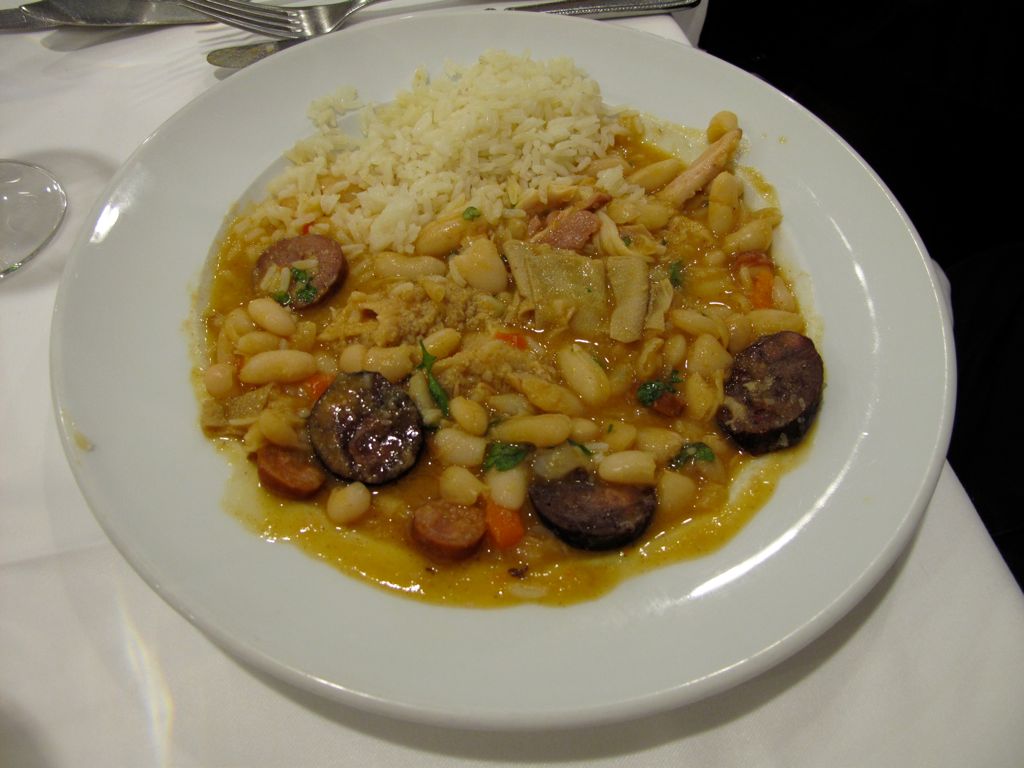
It was really quite delicious. Tripe wasn't even the main ingredient, it was almost a garnish next to the white beans and the sausage that made up the main part of the stew. The stew was served over rice.


When I got home, I decided that it was time to try my hand at cooking tripe. I live in a neighborhood with a butcher that carries three types of beautiful, snowy-white tripe next to the other cuts of meat that I buy, so it was not a problem to procure some good tripe for my experiment. The recipe came out of my Jean Anderson Portuguese cookbook:


I have grown to appreciate this somewhat previously under-used cookbook more and more since our trip to Portugal. The recipe for Tripas À Moda do Porto is quite time-consuming: the tripe is first cooked very slowly in the oven for 3 hours together with aromatics, before the beans, proscuitto & sausages are added and cooked further for another hour and a half. The result is a little different from the tripe we had in Porto, being much more tomato-y than we remembered, but retains the essential character of the authentic dish. The recipe made so much tripe that we were eating leftovers for quite a few days. I forgot to take pictures the first night we had it. The picture below was taken after the 3rd reheating in the oven, after which the stew had lost a lot of liquid. It was originally more soupy, perfect over rice, like the authentic dish we had in Porto.


The wine was, unfortunately, a rather uninspiring red, one of a few bottles of Portuguese red that we had bought to try out. I was glad I got around to cooking with tripe. It isn't as scary as it might seem at first. Although, the recipe was so time-consuming I don't know if I would make it again. Perhaps for a special occasion! A dinner party, perhaps, with adventurous eaters? I told my mother-in-law, who is a pretty adventurous eater, about the dish, and even she said that it would be OK if I didn't make it for her the next time she visits!

Wednesday, December 1, 2010

A Portuguese dessert in search of a better name

Why would you name your dessert "Rancid Cake"? This is precisely what we saw on the dessert list at a popular neighborhood restaurant in Lisbon. After a huge meal of garlic bread soup and salt cod baked with potatoes, we weren't really interested in dessert but took a look at the menu anyway, and this cake, because of its unusual name, caught our eye. Dave made up his mind immediately that he had to have it. The waiter explained that that the name had come about because of the use of "rancid butter" but followed with the promise that it was a very good cake. We decided to focus on the waiter's assessment of its deliciousness rather than on the potential rancidity of one of the ingredients, despite the opposing nature of these two details. And it was very good. I couldn't detect any hint of rancidness in it at all.

Anyway, after we came home, I saw an entry for "Putrid Cake" or "Bolo Podre" in another one of my Portuguese cookbooks:


The recipe does not use butter, but olive oil. The author theorizes that perhaps in the old days, the olive oil might have gotten rank or rancid, resulting in the unfortunate name, but prefers the alternative meaning of "podre" ("depraved" or "corrupt") to describe the influence of a rich and decadent cake.

Naturally, I had to make it to follow one of our Portuguese dinners. The list of ingredients is very interesting: finely ground anise seeds, 5 eggs in a total of 2 cups flour, olive oil, honey, and almost two cups of booze from a combination of tawny port, white wine and brandy. The top is supposed to crack as seen here:


We paired it with a semi-sweet madeira that we had brought home from Funchal, Madeira. This wasn't even the best madeira from our total Portuguese vacation haul:


but even so it was way better than the average bottle you can buy at your local wine store back at home. I can't wait to get into the other, better stuff!

So, what was the rest of the dinner like that I made to go with the Putrid/Corrupt Cake? I started this post backwards with dessert, but the rest of dinner was no less good. We had the Portuguese meatballs that I've made before again, this time paired with green beans with garlic, fresh coriander leaves, olive oil and lemon from the same cookbook that gave me the cake recipe. This is one of the best ways to prepare green beans that I have come across!


The Douro wine, made with Port grapes, was from our local gourmet purveyor of all things Iberian, The Spanish Table in Berkeley. It was a winner!